Introducing AI-Powered Domain Search: Search by Meaning, Not Spelling
Features
18 Aug 2026

Exact-match domains have long sparked debate among SEO professionals, with some viewing them as a shortcut to higher rankings and others questioning their long-term value. For years, many site owners believed that matching a domain to a target keyword could give them an edge in search results. That perception still influences decisions today, even as Google’s algorithms increasingly prioritize content quality, relevance, and authority. This raises a common question for anyone launching a site in 2026: Does using a keyword-focused domain still provide a meaningful SEO advantage?
To answer that, we first need to understand what these domains actually are and how they work today.
An exact-match domain is a domain name that exactly matches a keyword people search for. These domains became popular because early search algorithms relied on simple signals to determine relevance, and the presence of a keyword in the domain was among them. If someone searched for “cheap laptops” a domain like “cheaplaptops.com” had an easier time ranking even if its content was thin or its backlink profile was weak.
During the early 2000s and the early 2010s, this created a wave of sites built around search phrases rather than brand identity. Marketers used domains such as “bestcoffeemakerreviews.com,” “findusedcars.com,” and “bestrunningshoes.com” to quickly capture traffic. The strategy worked because search engines interpreted these names as direct indicators of topic relevance, a much simpler system than today’s quality- and trust-based approach. A very good german example is hosting.de, being a well known webhosting provider in germany. The exact match drives authority and trust to the brand.
This advantage pushed many small businesses, affiliate sites, and niche publishers to rely on keyword-focused domains as a fast entry point into competitive search results. It became a common tactic because it produced results without requiring strong content or long-term authority.
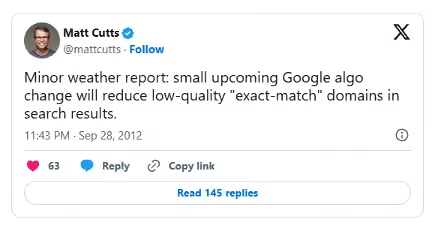
Google’s 2012 update, marked a major turning point in how exact-match domains were evaluated. The update was first announced publicly by Matt Cutts in a tweet explaining that Google was rolling out a change designed to reduce low-quality EMDs in search results. Shortly after the rollout, Moz published an early analysis showing that many thin or weak EMD sites saw significant ranking declines, confirming that Google was intentionally dialing back the advantage these domains previously enjoyed.
This shift forced site owners to move away from relying solely on domain wording. From that point forward, Google placed greater weight on content quality, topical depth, expertise, and trust signals rather than simplistic keyword matches in the URL. Subsequent core updates reinforced the same trend, emphasising helpful content, strong intent alignment, and user satisfaction as primary ranking factors.
In 2026, exact-match domains still have relevance, but their influence is limited. Google treats keywords in the domain name as a minor contextual signal rather than a meaningful ranking boost. The real performance drivers are the fundamentals that shape modern SEO:
A keyword-based domain can still be helpful in specific scenarios, such as niche topics, local queries, or long-tail searches, but its benefits are limited without these fundamentals. On its own, it contributes only a small relevance signal; it does not guarantee meaningful SEO results.
A domain that matches a search term immediately communicates what the site is about. This clarity can improve click-through rates, especially for niche or highly specific queries. Users instantly understand the site's focus, giving EMDs an advantage over more generic or ambiguous domains.
Even though Google claims that domain keywords have less influence on rankings, real-world results show EMDs still perform well in low-competition or non-YMYL niches. Aligning the domain with a target keyword reinforces relevance and can provide an early boost in search visibility.
Google sometimes interprets searches for a keyword that matches the domain as branded traffic. For example, when users search for “best running shoes,” Google may see the website “bestrunningshoes.com” as a recognized brand, even if people are just looking for the keyword. Branded traffic is a major ranking factor, giving EMDs a real advantage.
Backlinks built to an EMD naturally include the target keyword in the anchor text, reducing the risk of anchor over-optimization. This makes link-building easier and safer while still signaling relevance to search engines.
EMDs are particularly useful for low-effort experiments, short-term campaigns, or churn-and-burn projects where the goal is to rank quickly for a money keyword. They provide a faster path to initial visibility without requiring a large investment in branding or long-term content.
Newer EMD-style approaches include using the TLD as part of the keyword or phrase, such as whitelabelseo.agency or carpetcleaning.london. These domains offer the benefits of exact match relevance while maintaining a more brand-friendly appearance and flexibility.
A keyword-focused domain can restrict long-term brand growth. For example, a site named “bestcoffeemakerreviews.com” clearly defines its niche, but expanding into other kitchen appliances or lifestyle products may feel inconsistent. This can make brand evolution more challenging and reduce the domain’s broader market appeal.
Keyword-heavy domains can trigger negative perceptions among users. Domains that are overly long or stuffed with search terms may seem less trustworthy or professional, which can lower engagement and click-through rates. First impressions matter, and a domain perceived as spammy can undermine even high-quality content.
As search engines continue prioritizing content quality and site authority, the incremental SEO benefit of an EMD diminishes over time. While it may provide a small initial signal, relying on the domain for sustained traffic is risky without continuous investment in quality content, link building, and user experience.
When choosing and using an exact match domain, consider these guidelines:
In 2026, the cornerstone of SEO success is still high-quality, original content that directly addresses user intent. Content must be informative, well-structured, and relevant to the audience’s needs. Beyond content, factors like user experience, mobile optimization, page speed, and technical SEO all play a critical role in determining rankings. A site that performs poorly in any of these areas risks losing visibility, regardless of its domain choice.
Equally important are signals of authority and trust. Credible backlinks, consistent social engagement, and positive brand recognition help search engines evaluate a site’s reliability and relevance. While an exact match domain may provide a minor relevance cue, it cannot substitute for these core elements. Successful SEO strategies integrate domain choice with strong content, technical optimization, and user-focused design to achieve sustainable, long-term performance.
Search engines are getting better at understanding context, intent, and the relationships between topics. That shift means EMDs aren’t the automatic ranking shortcut they once were. Still, real-world results don’t always match Google’s claims. In many niches, especially those that aren’t YMYL or heavily competitive, EMDs continue to perform well. They can help new sites gain traction faster and work well for smaller experiments or projects where you’re trying to rank quickly without a large investment.
There are a few reasons why they still hold value. Sometimes Google treats keyword searches as branded searches because the domain itself is the exact phrase people type in. That can send strong signals that the site is a known brand, even if people are just searching for the keyword. Backlinks also come with natural keyword anchors, which reduces the usual concern about over-optimizing anchor text. While EMDs won’t replace the importance of strong content, authority, and technical performance, the right domain can still offer an edge when paired with a broader SEO strategy.
Exact match domains still have a place in SEO in 2026. They don’t guarantee rankings, and they can’t replace the fundamentals, but they can make an impact when they’re used in the right context. In many low-competition or non-YMYL niches, an EMD can still gain traction faster because it aligns directly with what people search for, often looks like branded traffic to Google, and naturally produces keyword-rich anchors without risking over-optimization.
The long-term results still depend on the same essentials: strong content, real authority, and a good user experience. But if the goal is to validate an idea, run a quick campaign, or move fast in a niche market, an exact match domain can still be a practical advantage. The best choice comes down to whether you’re building a long-term brand or aiming for quick wins.
---
Written by: Frederick (Freddy) Schiwek